Slots Explained 5 min read
Slot RNG and fairness: what the evidence can tell you
An RNG is one part of a slot system, not a blanket fairness certificate. Follow the path from number generation to game rules and learn which evidence actually supports a claim.

In this article
An RNG helps select numbers used by a slot’s game logic. It does not, by itself, prove that a particular game is authorized, correctly implemented, or favorable to the player. Checking fairness means checking the scope of the claim and the evidence for the actual product and version.
This article concerns conventional RNG-driven slots. It is not a description of every slot-shaped product, lottery terminal, Class II bingo-based system, or game with persistent features. Similar graphics can sit on top of different outcome-determination systems.
We did not inspect source code, collect raw RNG output, or test a real game for this article. The aim is to explain the questions a reader can reasonably ask without presenting an editorial article as a certification.
Follow three separate layers
A simplified way to think about the system is:
- Number generation: the RNG produces values.
- Game rules: software maps those values to outcomes and evaluates awards under the relevant configuration.
- Presentation: the interface shows the resulting symbols, animations, and payout information.
This is a conceptual diagram, not a claim that every implementation has three separate components or performs every action in that visual order.
Nevada’s Technical Standard 1, revised February 26, 2026, defines RNG terminology and addresses random-selection requirements. Pennsylvania’s design standard, subsection (d), separately addresses random selection and accurate display of the selected result. These are identifiable state examples, not a single nationwide specification.
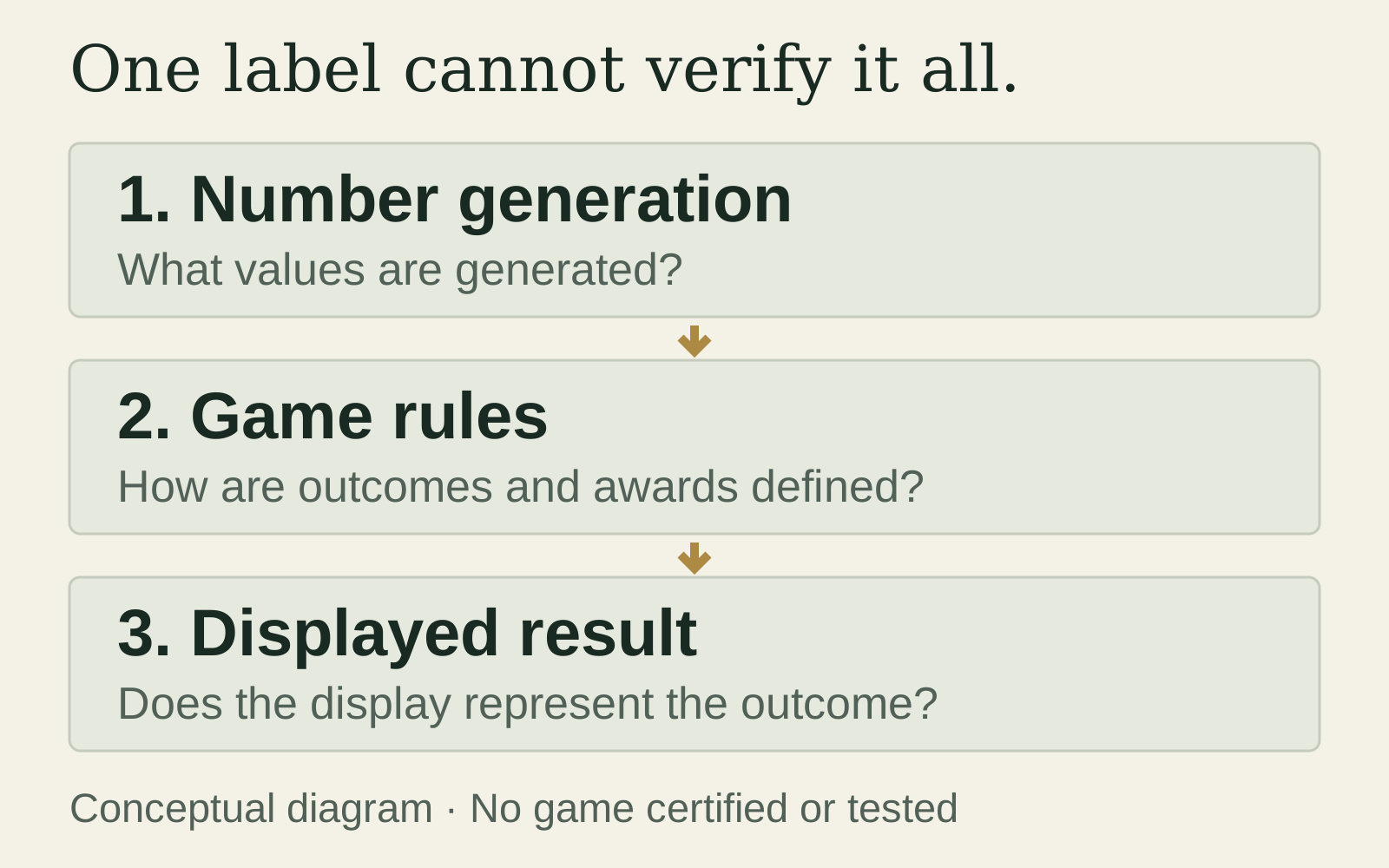
That separation explains why an impressive animation is not evidence about probabilities. The animation is what you can see. The mapping, configuration, and implementation require their own documentation and checks.
Random does not mean all prizes are equally likely
Unpredictability and equal probabilities are different properties. Here is a hypothetical illustration, unrelated to a real game: imagine 100 equally likely numbered tickets. A written rule assigns one ticket to a large award, nine to a smaller award, and 90 to no award.
The tickets can be sampled randomly while the three award categories remain unequal in probability. The example illustrates the difference between random selection and outcome weighting; it does not describe reel strips, an actual slot’s architecture, or a profitable strategy.
Nor does randomness imply a positive expected return. The separate questions of average payout and outcome variation belong in our RTP and volatility explanation. An RNG label cannot replace those mathematical specifications.
A streak is not a prediction
For a model with independent trials and unchanged rules, earlier wins or losses do not change the probability assigned to the next trial. A run of losses therefore does not establish that a prize is due. It also cannot tell you exactly when a losing run will end.
The scope of “independent” matters. A game can have a documented state, such as collected items or an active feature, that changes which rules apply. Do not treat a blanket slogan about every spin as a substitute for reading those rules. Also do not infer a hidden state or an advantage from an animation.
A personal sequence of outcomes may be worth documenting when reporting a specific malfunction. It is not, by itself, a complete statistical test or proof of wrongdoing. A credible allegation needs an identifiable product, relevant records, and a process capable of investigating it.
What testing evidence should identify
Start by asking what was examined: an RNG component, a specific game build, a complete system, or an operator’s procedures. These are different scopes. A logo beside a game does not answer the question.
GLI-11 version 3.0, in “About This Standard,” describes testing submitted equipment and issuing a certificate of compliance with that standard. Section 1.3.3 says regulators may adopt the standard in whole or in part. A standards document or laboratory logo therefore does not establish that a particular game or operator is authorized in a U.S. jurisdiction. You still need the matching product record and applicable regulatory approval.
A useful evidence record identifies:
- The issuing regulator or laboratory and the original document location.
- The product, software version, configuration, and jurisdiction in scope.
- The date, status, and limitations of the approval or report.
- Whether the claim concerns testing, authorization, or continuing operation.
- Any mismatch between the document and the product being discussed.
If that record is unavailable, state the limitation. Do not convert “the developer mentions testing” into “we independently verified this game.”
Passing a randomness test is not a universal guarantee
NIST’s SP 800-22 publication page explains that statistical tests cannot replace cryptanalysis—the security analysis of a generator. The document dates to 2010; its 2022 revision decision calls for clarifying its purpose and rejecting its use to assess cryptographic RNGs. Do not treat the old test suite as a complete security evaluation or a casino certificate.
Testing a visible stream of prizes also differs from testing raw generator output. Without knowing the transformation from numbers to awards, a reader cannot assume that the two datasets should have the same distribution. A small spreadsheet of session results cannot substitute for the required inputs and methodology.
The Nevada document illustrates another research trap: section 1.400 contains different software-RNG provisions depending on whether an electronic gaming device was approved before January 1, 2027, or on/after that date. As of the October 28, 2026 source check, that latter date is still in the future. Do not describe a future approval condition as a current rule for every machine in service.
A practical evidence check
Write the claim in a full sentence. “This report covers this version’s RNG” is narrower and more useful than “the game is fair.” Open the original record, compare its identifiers with the product, and record what you could not confirm.
Use our paytable checklist for the rule and payout layer. Treat a missing identifier, an inaccessible report, or a third-party summary as a research gap rather than filling it with confidence.
No evidence review makes gambling outcomes predictable or removes financial risk. This article provides a way to evaluate claims, not an endorsement, legal conclusion, or promise about a real game.
The paper trail
Sources & verification
- Nevada Technical Standard 1, revised February 26, 2026, section 1.400
Nevada Gaming Control Board · Checked 2026-10-28
- 58 Pa. Code section 461a.7: Slot machine minimum design standards
Pennsylvania Code and Bulletin · Checked 2026-10-28
- NIST SP 800-22 Rev. 1a: statistical tests for random and pseudorandom number generators
National Institute of Standards and Technology · Checked 2026-10-28
- Decision to Revise NIST SP 800-22 Rev. 1a, April 19, 2022
National Institute of Standards and Technology · Checked 2026-10-28
- GLI-11 Gaming Devices version 3.0: About This Standard and section 1.3.3
Gaming Laboratories International · Checked 2026-10-28
A source check is not a publication approval. We identify jurisdiction-specific material and do not present it as US legal advice.
Keep exploring
More context. Better understanding.
RTP vs. volatility: what each tells you about a slot
RTP describes a model's average return; volatility describes how widely outcomes vary. Neither predicts a session. Two transparent toy models show the difference.

How to read a slot paytable without guessing
Read the units, winning conditions, and feature exceptions before interpreting a prize. A five-step evidence worksheet helps separate documented rules from assumptions.