Slot Guides 5 min read
How to read a slot paytable without guessing
Read the units, winning conditions, and feature exceptions before interpreting a prize. A five-step evidence worksheet helps separate documented rules from assumptions.
In this article
To read a slot paytable, identify the game version, establish what the payout numbers mean, and then check the conditions for each winning combination. Do not start by assuming that a large number is a cash amount or that matching symbols anywhere on the screen must pay.
A paytable is a map of stated awards and conditions. It is not a forecast of how often you will receive them. This guide supplies a repeatable reading routine, a transparent arithmetic example, and a short evidence worksheet. It does not recommend where or how much to wager.
Step 1: identify the document you are reading
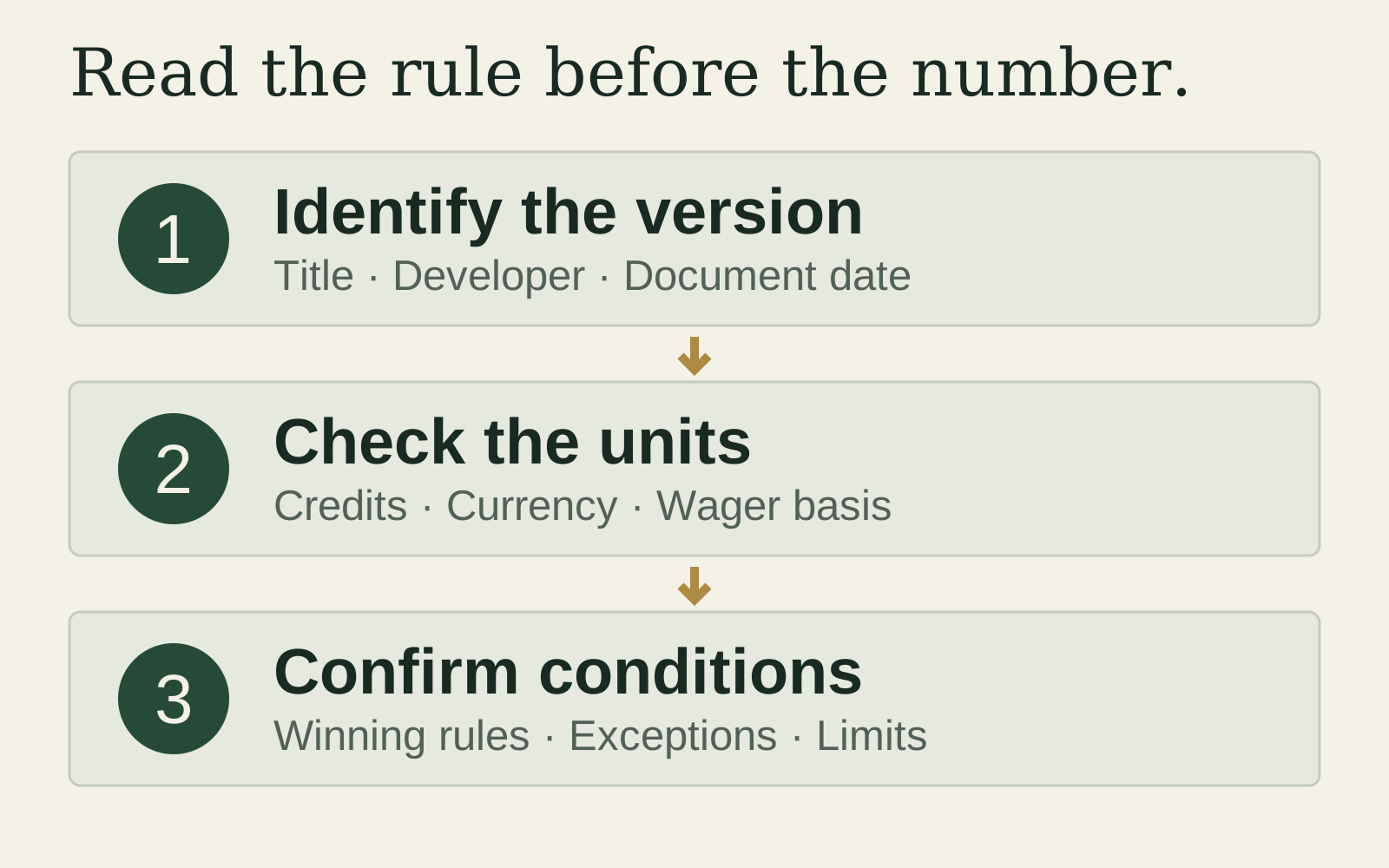
Open the game’s own rules or help screens when they are accessible without a purchase or wager. Record the title, developer if documented, platform, visible version identifier, and the date. If you only have an unaffiliated screenshot, record that limitation.
Keep a game’s base rules and its separate feature rules together. A familiar brand name is not enough to prove that two documents describe the same configuration. If a version number is unavailable, write “version not displayed” rather than inventing one.
A useful note might read: “Help screen; title as displayed; version not displayed; checked on [actual date].” Do not describe an unidentified document as the latest version.
Step 2: establish the payout units
Find the sentence explaining the numbers beside each symbol. They might represent credits, a multiple of a line wager, a multiple of a total wager, or a displayed currency amount. Use the document’s wording; do not infer the basis from a familiar-looking interface.
GLI-11 version 3.0, sections 4.3–4.4, addresses line displays, payout units, winning combinations, and the scope of multipliers. It is a technical standard that a regulator may adopt, not evidence that every product follows the same rules.
Here is a hypothetical arithmetic example, not a real game’s paytable:
- The stated rule pays 20 times the line wager for one qualifying combination.
- The assumed line wager is $0.05.
- The calculated award for that combination is
20 × $0.05 = $1.00. - If the assumed total wager across ten lines is $0.50, multiplying 20 by $0.50 would use the wrong basis for this example.
The award is a gross payout for the combination, not automatically a net profit. In this invented single-win example, subtracting the $0.50 total cost of the spin leaves $0.50. A different basis, simultaneous wins, or an additional feature cost changes the calculation. These are teaching assumptions, not actual game data or a recommended stake.
Step 3: trace a winning combination
Ask how a win is evaluated, then follow one example through the written rules.
- Is a named line or path required?
- Must matches begin on a particular reel, or can they begin elsewhere?
- Are adjacent reels required?
- Does the game use a ways, cluster, or other rule instead of a fixed line?
- If several combinations overlap, which awards are counted?
A diagonal group may still fail the stated conditions. For a same-grid comparison of the two evaluation methods, see paylines versus ways to win. This checklist focuses on finding the relevant rules rather than assuming a universal pattern.
The UK Gambling Commission’s RTS 3 separates understandable rules, likelihood information, and potential awards. We use that distinction as a reading aid; the UK framework does not establish what is required in every U.S. state.
Step 4: read symbol and feature exceptions
Do not let a symbol’s name stand in for its rules. For a wild, check what it can replace and any exclusions. For a scatter, check whether it pays, triggers a feature, or does both. Locate any minimum count, reel restriction, or mode-specific behavior.
For features, write down the entry condition, what changes during the feature, and how it ends. Check whether a multiplier applies to one award, a group of awards, or a stated total. Preserve limits and qualifying text when taking notes.
If a maximum prize is advertised, look for the conditions attached to that claim. Do not describe a theoretical maximum as a typical outcome, a likely bonus result, or evidence that it occurred during testing.
Reading rules can establish what a document claims. It cannot establish the probability of a feature when that probability is not supplied. Missing information should remain missing in a review.
Step 5: save a compact evidence worksheet
Use five short fields for each important claim:
- Claim: what the rule actually says.
- Location: help-screen heading, page, or source link.
- Configuration: visible version, mode, and units.
- Checked: the actual research date.
- Limitation: what could not be confirmed.
For example, “Multiplier applies to line award; page headed Base Game; version not displayed; date checked; feature-mode application not confirmed” preserves a useful boundary. It is more reliable than copying a confident but uncited summary.
The Pennsylvania slot-machine rule, subsection (f), addresses access to winning combinations and rules when a machine is idle. That is one state-specific provision, not a promise that every online help screen contains a complete probability model.
What a paytable cannot prove
A readable rulebook does not by itself verify the implementation, independent testing, an operator’s authorization, or what a future session will return. A screenshot is not a certification.
For mathematical terms, continue with RTP versus volatility. For the distinction between rules, outcome generation, and supporting evidence, read RNG and slot fairness. Those are separate questions; this guide’s job is to make the stated rules traceable.
No real game was played or audited for this article. The example and worksheet are original teaching material.
The paper trail
Sources & verification
- GLI-11 Gaming Devices version 3.0, sections 4.3 and 4.4
Gaming Laboratories International · Checked 2026-10-28
- RTS 3: Rules, game descriptions and the likelihood of winning
UK Gambling Commission · Checked 2026-10-28
- 58 Pa. Code section 461a.7: Slot machine minimum design standards
Pennsylvania Code and Bulletin · Checked 2026-10-28
A source check is not a publication approval. We identify jurisdiction-specific material and do not present it as US legal advice.
Keep exploring
More context. Better understanding.
RTP vs. volatility: what each tells you about a slot
RTP describes a model's average return; volatility describes how widely outcomes vary. Neither predicts a session. Two transparent toy models show the difference.
Paylines vs. ways to win: how combinations are counted
Paylines check named paths; a common ways system checks eligible positions on consecutive reels. A same-grid example shows why combination counts are not win probabilities.
Slot RNG and fairness: what the evidence can tell you
An RNG is one part of a slot system, not a blanket fairness certificate. Follow the path from number generation to game rules and learn which evidence actually supports a claim.