Slots Explained 5 min read
Paylines vs. ways to win: how combinations are counted
Paylines check named paths; a common ways system checks eligible positions on consecutive reels. A same-grid example shows why combination counts are not win probabilities.
In this article
A payline checks a specified path through reel positions. A common ways-to-win system checks matching symbols on consecutive reels without requiring one drawn path. The game’s rules still decide the starting reel, required number of matches, eligible positions, and treatment of overlapping awards.
The distinction is about recognizing combinations. A label such as “243 ways” does not tell you the probability of a payout, the expected return, or whether a game is suitable for you.
A line is a path; ways use eligible positions
Imagine three horizontal paylines: top, middle, and bottom. Under a rule requiring three matching symbols, each of those paths is checked separately. Matching symbols that do not share an active path do not qualify under that rule.
Now change the rule, while keeping the displayed grid. In our example of an adjacent-reel ways system, an A in any eligible position on reel one can combine with an A on reel two and an A on reel three. Row position no longer restricts that particular combination.
These are specified teaching rules, not a claim that every payline or ways game works identically. A game may require a different starting reel, pay in both directions, restrict positions, or change its rules during a feature. Check the actual help document before interpreting a screen.
For a technical treatment, Chapter 3 of Elements of Slot Design, second edition distinguishes adjacent-reel ways from evaluating the same screen as a set of paylines. It is a 2013 design text, not a current game specification or a U.S. regulatory rule.
One grid, two different results
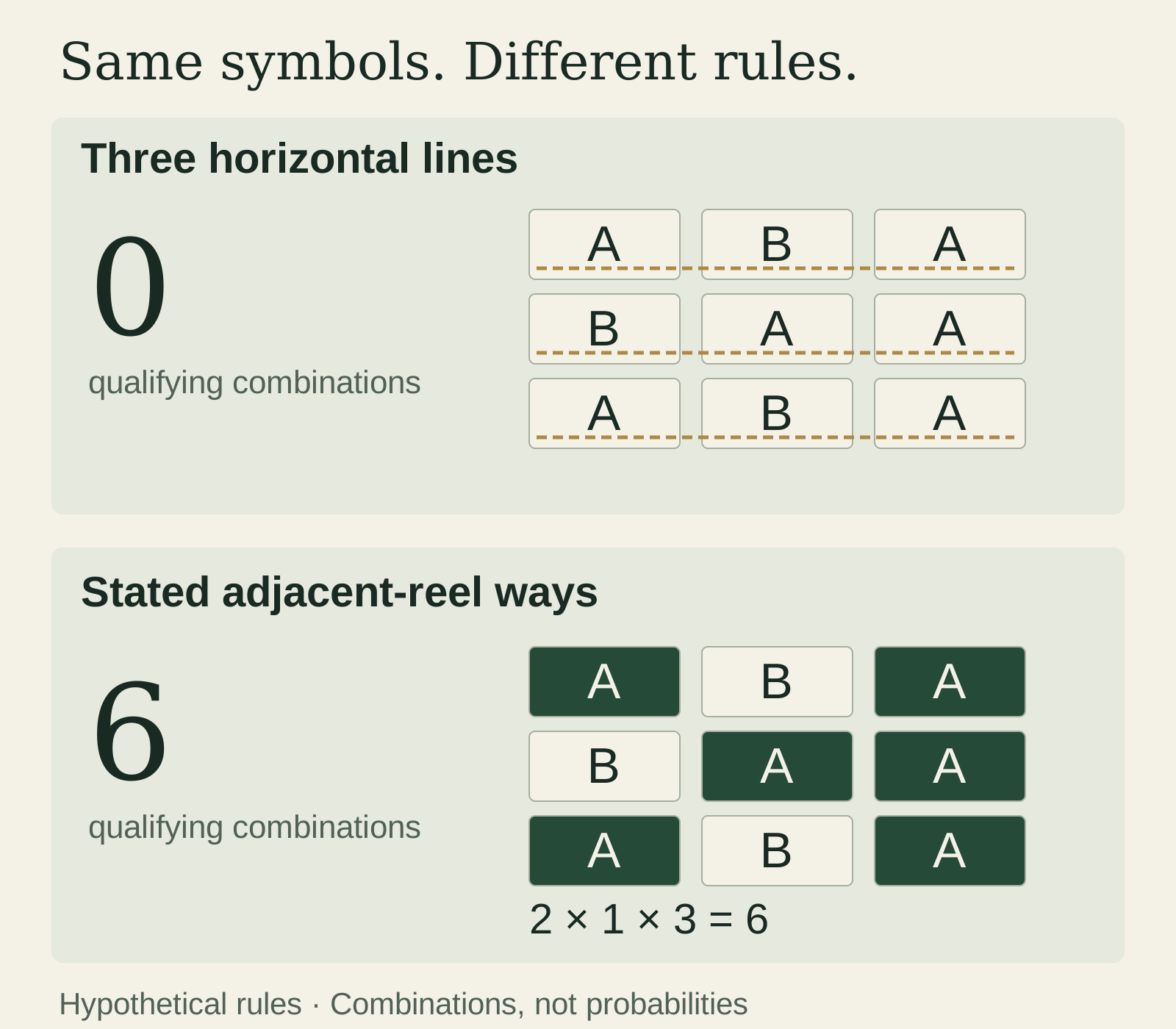
Here is an invented three-reel grid. Only the letter A qualifies for the three-symbol combination. There are no wilds, scatters, features, or other awards.
- Top row: A · B · A
- Middle row: B · A · A
- Bottom row: A · B · A
With only the three horizontal paylines active, none forms A–A–A. The middle A is on a different row from either A on the first reel.
Under our adjacent-reel ways rule, the first reel has two eligible As, the second has one, and the third has three. That makes 2 × 1 × 3 = 6 qualifying three-A position combinations.
| On this teaching grid | Three horizontal paylines | Stated adjacent-reel ways |
|---|---|---|
| What is checked | Three specified row paths | Eligible A positions on consecutive reels |
| Row or path restriction | Matches must share one horizontal path | Matching positions may be on different rows |
| A counts on reels 1–3 | 2 / 1 / 3; checked along the stated paths | 2 / 1 / 3; multiplied under the stated rule |
| Qualifying A–A–A combinations | 0 | 6 |
Changing the rule without changing any other assumptions is useful for explanation. A real game’s designer may change awards, symbol weights, costs, or features too. This example does not establish which real game would return more.
What “243 ways” actually counts
For a hypothetical five-reel layout with three eligible positions per reel, choosing one position from each reel gives 3 × 3 × 3 × 3 × 3 = 243 full-length position combinations.
That calculation does not say that all 243 combinations match, pay, or are equally likely. It also does not describe every shorter win. The rules determine whether three, four, or five consecutive matches qualify and how the highest award and overlapping combinations are handled.
Keep two counts separate:
- Available position combinations: the combinations permitted by the layout and evaluation rule.
- Qualifying combinations on a displayed result: the combinations that actually satisfy a particular symbol rule.
The six three-A combinations above are the second kind. The headline 243 is a layout count in the five-reel example. Neither is a probability without a model of how the symbols are generated.
More ways does not establish a higher return
A combination count leaves out important parts of a game’s mathematics: symbol probabilities, award values, feature rules, and the cost of a play. Without those inputs, you cannot calculate a win probability or RTP from a line or ways count alone.
Do not assume a fixed conversion between “ways” and a line wager, either. Read the displayed total cost and the documented payout basis. For the distinction between gross awards and net results, use our paytable reading checklist. For expected return and variation, read RTP versus volatility.
Check the rule that answers your question
Look for these details when a combination is unclear:
- Which reel must a match start on, and how many consecutive reels are required?
- Which positions are eligible, and does a feature change them?
- Does only the highest qualifying combination pay?
- How are wild substitutions and overlapping awards handled?
- What units and wager basis determine the award?
GLI-11 version 3.0, sections 4.3.5 and 4.4.1, provides a useful technical reference for line displays and explaining evaluation rules. It is not a rule applied uniformly to every U.S. product.
If you cannot find a condition, mark it unconfirmed. A familiar-looking grid is not a substitute for the rules, and a clear rule description does not certify the software. Our RNG and fairness guide explains that separate evidence question.
This article explains how to read a combination rule; it does not recommend a game or a wager. More opportunities displayed on a screen do not make a future result predictable.
The paper trail
Sources & verification
- Elements of Slot Design, second edition, Chapter 3: 243 Ways Games
Game Design Automation · Checked 2026-10-28
- GLI-11 Gaming Devices version 3.0, sections 4.3.5 and 4.4.1
Gaming Laboratories International · Checked 2026-10-28
A source check is not a publication approval. We identify jurisdiction-specific material and do not present it as US legal advice.
Keep exploring
More context. Better understanding.
RTP vs. volatility: what each tells you about a slot
RTP describes a model's average return; volatility describes how widely outcomes vary. Neither predicts a session. Two transparent toy models show the difference.
How to read a slot paytable without guessing
Read the units, winning conditions, and feature exceptions before interpreting a prize. A five-step evidence worksheet helps separate documented rules from assumptions.
Slot RNG and fairness: what the evidence can tell you
An RNG is one part of a slot system, not a blanket fairness certificate. Follow the path from number generation to game rules and learn which evidence actually supports a claim.