Slots Explained 5 min read
RTP vs. volatility: what each tells you about a slot
RTP describes a model's average return; volatility describes how widely outcomes vary. Neither predicts a session. Two transparent toy models show the difference.

In this article
RTP and volatility answer different questions. Return to player, or RTP, describes the average amount a game’s mathematical model returns relative to wagers. Volatility concerns the variation around an average. A percentage does not tell you when a prize will arrive, and a volatility label does not tell you what your next session will cost.
Compare the measure, the game configuration, and the supporting source—not just the percentage. This guide uses a transparent example rather than recommending a game.
RTP measures an average, not your session
A theoretical RTP belongs to a specified game model. The UK Gambling Commission’s consumer explanation distinguishes an average over extensive play from a return during one person’s session.
Consider a hypothetical model with 90% RTP. For each unit wagered, its mathematical average payout is 0.90 units. The complementary 0.10 units is a 10% theoretical house edge under that model. Neither figure says that a person depositing $100 receives $90 back. A deposit, the sum of wagers, and the ending balance are different quantities.
The arithmetic describes expected values. It does not create a refund, a time limit for losses, or a point at which the game owes a player money. Increasing the number of wagers does not create a guarantee of breaking even.
Volatility describes the spread of outcomes
The Commission’s technical glossary distinguishes theoretical RTP from observed RTP and explains volatility through variation in prizes, commonly expressed as standard deviation.
A low, medium, or high label needs context. Without a documented scale and method, two providers’ labels should not be assumed comparable. Check whether the label comes from the developer, a test report, or an editor’s impression.
“Low” does not mean safe, and “high” does not mean a larger next win is due. A game can have a negative expected return under either description. A label alone also cannot establish the probability of a bonus, the size of a possible loss, or the distribution of a full session.
Same RTP, different distributions: a worked example
These two invented teaching models are not real slots. Each trial costs one unit. A payout includes everything returned from that trial.
- Model A: a 50% chance of paying 1.80 units and a 50% chance of paying nothing.
- Model B: a 10% chance of paying 9 units and a 90% chance of paying nothing.
The expected payout for A is 0.50 × 1.80 + 0.50 × 0 = 0.90 units. For B, it is 0.10 × 9 + 0.90 × 0 = 0.90 units. Dividing each by its one-unit cost produces the same 90% theoretical return.
B concentrates its payout in a rarer, larger outcome. Its single-trial payout standard deviation is 2.70 units, compared with A’s 0.90 units. Those numbers follow directly from these stated probabilities; they are not volatility ratings for actual games.
| Teaching-model measure | Model A | Model B |
|---|---|---|
| Cost per trial | 1 unit | 1 unit |
| Probability of a nonzero payout | 50% | 10% |
| Prize when paid | 1.80 units | 9 units |
| Expected payout / theoretical RTP | 0.90 units / 90% | 0.90 units / 90% |
| Single-trial payout standard deviation | 0.90 units | 2.70 units |
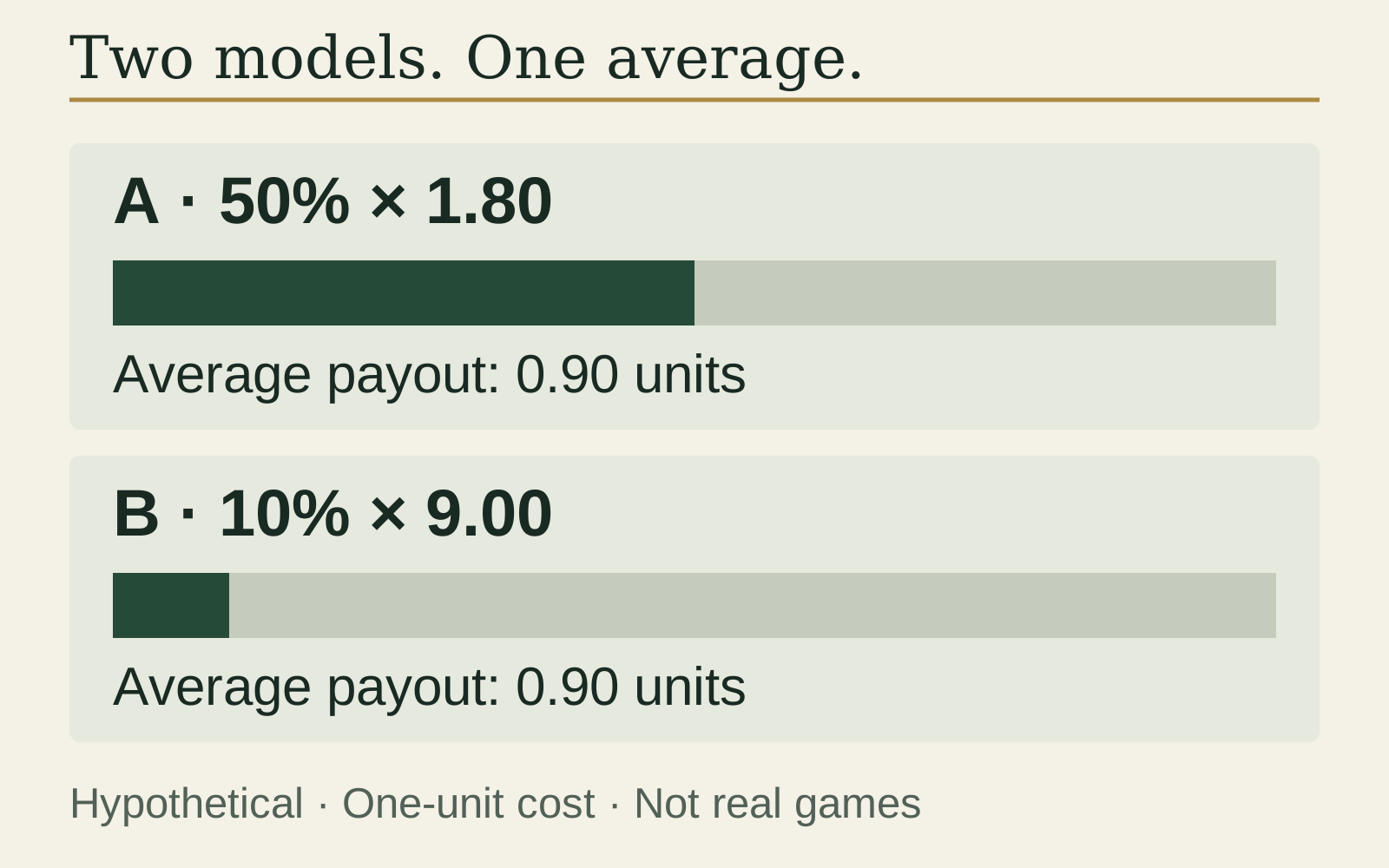
This comparison shows why an average cannot describe an entire distribution. It does not tell us the complete behavior of a real slot, which may contain multiple prizes, features, and game states. It also does not simulate a player’s results.
Theoretical RTP and observed RTP are not interchangeable
An observed return is calculated for a defined set of wagers and payouts. For another hypothetical example, $95 paid out across $100 of wagers gives an observed return of 95% for that sample. It does not establish that the game’s theoretical RTP is 95%.
Use wagers as the denominator, not the original deposit. If someone deposits $20 and repeatedly wagers returned credits, the total wagered can exceed $20. Comparing all payouts with the deposit would answer a different question.
The Commission’s monitoring guidance considers play volume and volatility when evaluating deviations. It does not support declaring a game correct or incorrect from a few personal results. This article has no operator-level dataset, confidence interval, or audited return measurement.
Check the configuration before comparing percentages
A game title is not a complete specification. When collecting an RTP claim, record:
- The exact title, developer, and any visible game or build identifier.
- The market or jurisdiction and where the rules were accessed.
- The wager mode, feature options, and any jackpot contribution covered by the figure.
- Whether the percentage comes from in-game help, a developer document, or a secondary review.
- The check date and any unresolved mismatch.
If the configuration cannot be identified, label the figure unverified. Do not borrow a percentage from another site’s review merely because its title artwork matches.
There is no single percentage in this guide that defines the legal minimum throughout the United States. For example, Pennsylvania’s slot-machine design rule describes its own theoretical-payout framework and wager conditions. That state-specific provision is not a national rule or a verified specification for any game discussed here.
Put the numbers in context
For the practical next step, use our paytable reading checklist to record units and conditions. To understand the separate question of outcome selection and testing evidence, read RNG and slot fairness.
RTP describes a model, volatility describes variation, and an observed return describes a sample. None makes a session a reliable source of income. If gambling is causing financial pressure or feels difficult to control, our responsible gaming information links to independent support.
The UK sources above support technical definitions in their own regulatory context. The Pennsylvania source supports only the expressly identified state example. This article does not verify a particular game, certify fairness, or provide U.S. legal advice.
The paper trail
Sources & verification
- Return to player: how much gaming machines payout
UK Gambling Commission · Checked 2026-10-28
- Key terms relating to live return to player performance monitoring
UK Gambling Commission · Checked 2026-10-28
- Live return to player performance monitoring of games of chance
UK Gambling Commission · Checked 2026-10-28
- 58 Pa. Code section 461a.7: Slot machine minimum design standards
Pennsylvania Code and Bulletin · Checked 2026-10-28
A source check is not a publication approval. We identify jurisdiction-specific material and do not present it as US legal advice.
Keep exploring
More context. Better understanding.

How to read a slot paytable without guessing
Read the units, winning conditions, and feature exceptions before interpreting a prize. A five-step evidence worksheet helps separate documented rules from assumptions.

Slot RNG and fairness: what the evidence can tell you
An RNG is one part of a slot system, not a blanket fairness certificate. Follow the path from number generation to game rules and learn which evidence actually supports a claim.